Strapi Explained: From Headless CMS to Customizable Node.js API Backend
When a product needs both an editor-friendly content system and a shared API for websites, mobile apps and other clients, rebuilding CRUD endpoints, an admin UI, permissions and media handling is rarely the best use of engineering time. Strapi turns those recurring requirements into configurable infrastructure while preserving an escape hatch to code.
This article uses Strapi 5 as its baseline. We will answer four questions: What is Strapi? What is it built with? How does a content model become an API? And how does it really differ from Java, Go and Python backend stacks?
1. What is Strapi?
Strapi is an open-source, self-hostable headless CMS and a content-centered Node.js backend framework.
“Headless” does not mean there is no admin interface. It means the CMS does not own the visitor-facing presentation layer:
- Editors create articles, products, campaigns and media in Strapi Admin.
- Strapi stores that structured content and exposes it through REST or GraphQL.
- React, Vue, Next.js, Nuxt, Flutter, mini apps and smart devices can consume the same source.
- Frontend rendering and deployment evolve independently from the CMS.
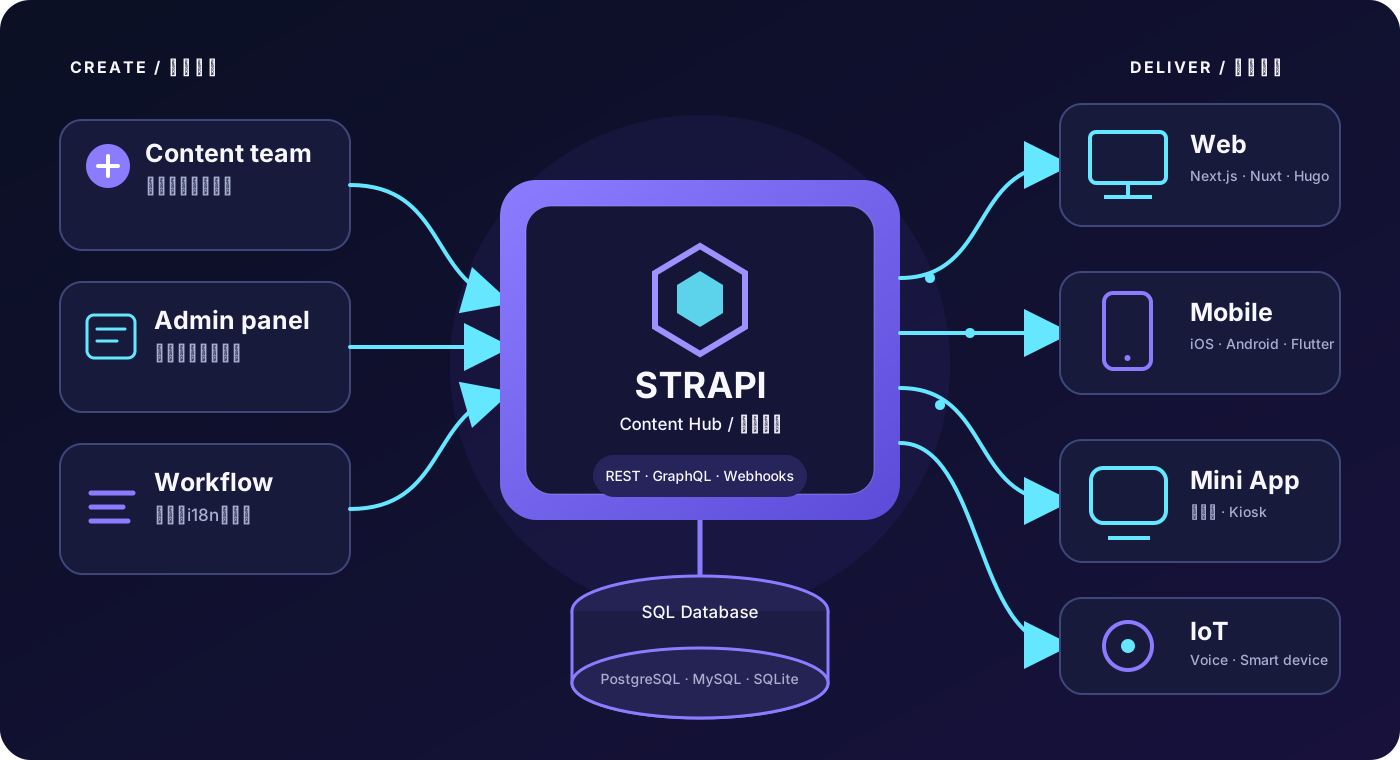
A traditional CMS tends to couple content management with page templates. Strapi focuses on content and APIs. A useful mental model is: a backend starter with visual modeling, an admin application and content-aware permissions already included.
A comparison caveat: Strapi is not a peer of Java, Go or Python. It is a product and framework; the others are languages and ecosystems. The meaningful comparison is Strapi against Spring Boot, Go web frameworks, and Django/DRF or FastAPI.
2. Core characteristics
| Capability | What it gives you | Caveat |
|---|---|---|
| Visual content modeling | Fields, relations, components and dynamic zones in Content-Type Builder | Complex domains still require deliberate engineering |
| Generated REST API | CRUD endpoints appear with the content type | New content types are private by default |
| GraphQL support | A plugin generates queries and mutations from the model | Query depth and cost must be controlled |
| Full admin application | Editing, media, draft/publish and localization workflows | Deep Admin customization is React development |
| Extensible backend | Routes, policies, middleware, controllers, services and lifecycle logic | More custom logic calls for more tests and layering |
| SQL database options | SQLite, PostgreSQL, MySQL and MariaDB | Strapi 5 does not support MongoDB or taking over arbitrary existing databases |
| API security | Public/authenticated roles, API tokens and action permissions | Rate limits, auditing and secret management remain your responsibility |
| Cloud or self-hosting | Keep control of code and data, or use Strapi Cloud | Self-hosting means owning upgrades, backups and observability |
Strapi’s central advantage is not record-breaking throughput. It is delivering a recurring bundle in one system:
database model + CRUD API + content admin + permissions + media + publishing workflow.
3. The technology stack
| Layer | Main technology | Responsibility |
|---|---|---|
| Runtime | Node.js | Runs the JavaScript/TypeScript backend; strong for I/O-heavy work |
| Application code | TypeScript or JavaScript | Configuration, controllers, services, policies and plugins |
| HTTP layer | Koa ecosystem and Strapi routing | Request handling and middleware execution |
| Admin | React + Strapi Design System | Content and system management UI |
| Content data access | Document Service / Query Engine | Documents, locales, draft/publish state and relations |
| SQL abstraction | Knex | SQLite, PostgreSQL and MySQL-family connections |
| Delivery API | REST; optional GraphQL plugin | Delivers content to consumers |
| Extensions | Plugins, providers, middleware, policies and lifecycle hooks | Storage, email, auth and business rules |
The Document concept matters in Strapi 5. One logical article may have draft and published variants in several locales. A documentId groups those variants, so the single-document REST route is:
|
|
not the numeric-ID route shown in many Strapi v4 tutorials. Strapi 5 also flattened REST responses: content fields sit directly on data, rather than under data.attributes.
4. How does Strapi generate an API?
Strapi follows a Content Model First approach. Describe the content structure once, and the framework assembles the database representation, Admin forms and delivery APIs around it.
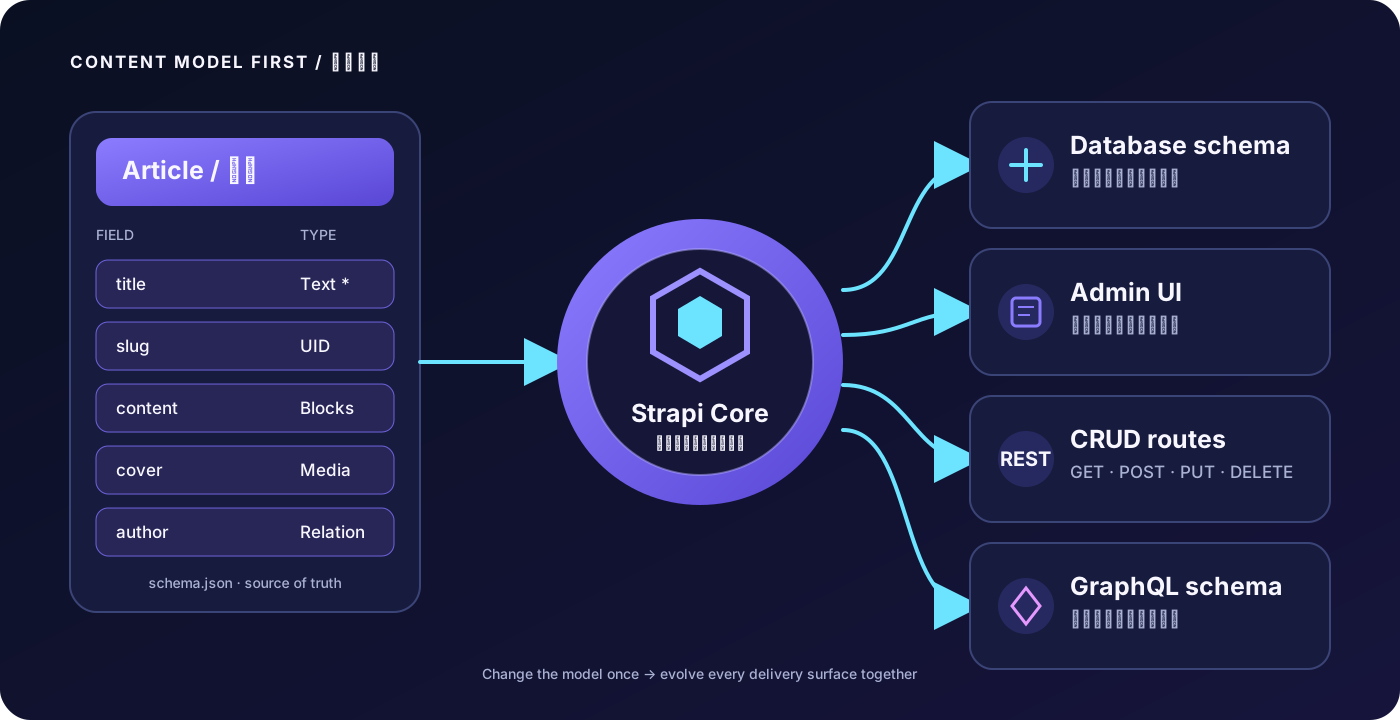
Suppose we create an Article collection type:
| Field | Type | Constraint |
|---|---|---|
title |
Short text | Required |
slug |
UID | Unique, based on title |
summary |
Long text | Optional |
content |
Blocks / rich text | Body |
cover |
Media | Single image |
author |
Relation | Many articles to one author |
featured |
Boolean | Defaults to false |
When the model is saved, Strapi:
- persists the model as a project schema;
- synchronizes tables, columns and relations;
- creates Admin list and edit screens;
- registers core controllers and services;
- registers REST CRUD routes under
/api/articles; - adds the model to GraphQL when the plugin is installed.
| Operation | Method and path |
|---|---|
| List | GET /api/articles |
| Retrieve one | GET /api/articles/:documentId |
| Create | POST /api/articles |
| Update | PUT /api/articles/:documentId |
| Delete | DELETE /api/articles/:documentId |
4.1 Build the first API
|
|
Open http://localhost:1337/admin, create the administrator account, then define Article in Content-Type Builder.
New content types are private by default. You may grant only find and findOne to the Public role, or create an API token for a trusted server. In production, scoped tokens are generally preferable to public write endpoints.
Fetch published articles:
|
|
Filter articles and explicitly populate their cover and author:
|
|
Create a document by wrapping business fields in data:
|
|
A Strapi 5 list response has this shape:
|
|
Relations, media, components and dynamic zones are not populated by default. Avoid blindly using
populate=*in production. Select fields and relations intentionally to control payload size and database cost.
4.2 When generated CRUD is not enough
Strapi does not lock you into generated behavior. A custom GET /api/articles/featured endpoint can be implemented with a route, controller and service:
|
|
|
|
|
|
The controller does not need to build SQL directly. Requests move through a layered pipeline:
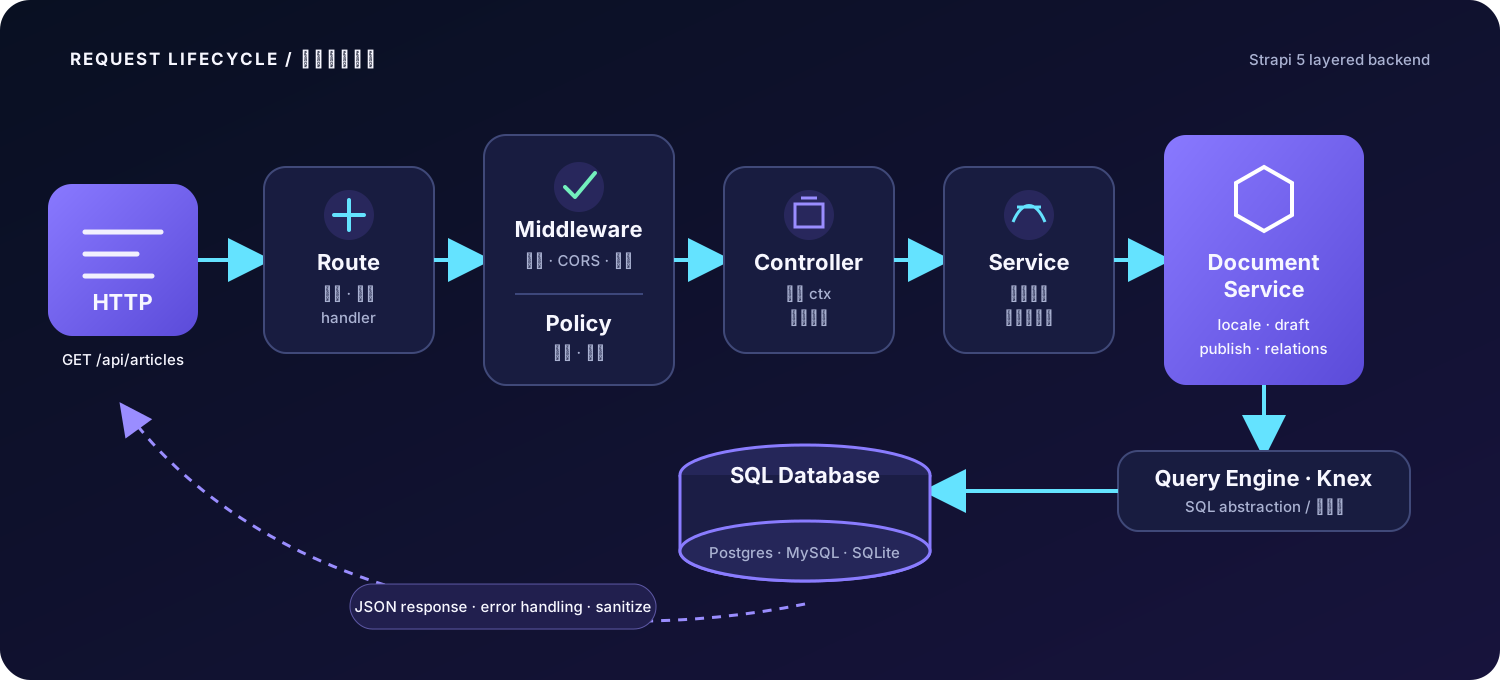
- Route selects the method, path and handler.
- Middleware handles logging, CORS, rate limiting and request transformations.
- Policy authorizes the current identity for the action.
- Controller interprets the HTTP context and shapes the response.
- Service owns reusable business logic.
- Document Service applies Strapi’s document, locale and publication semantics.
- Database / Knex finally accesses the relational database.
This resembles controller/service/repository layering in Spring or Django. The difference is how much default behavior Strapi has already supplied.
5. Strapi vs Java, Go and Python backends
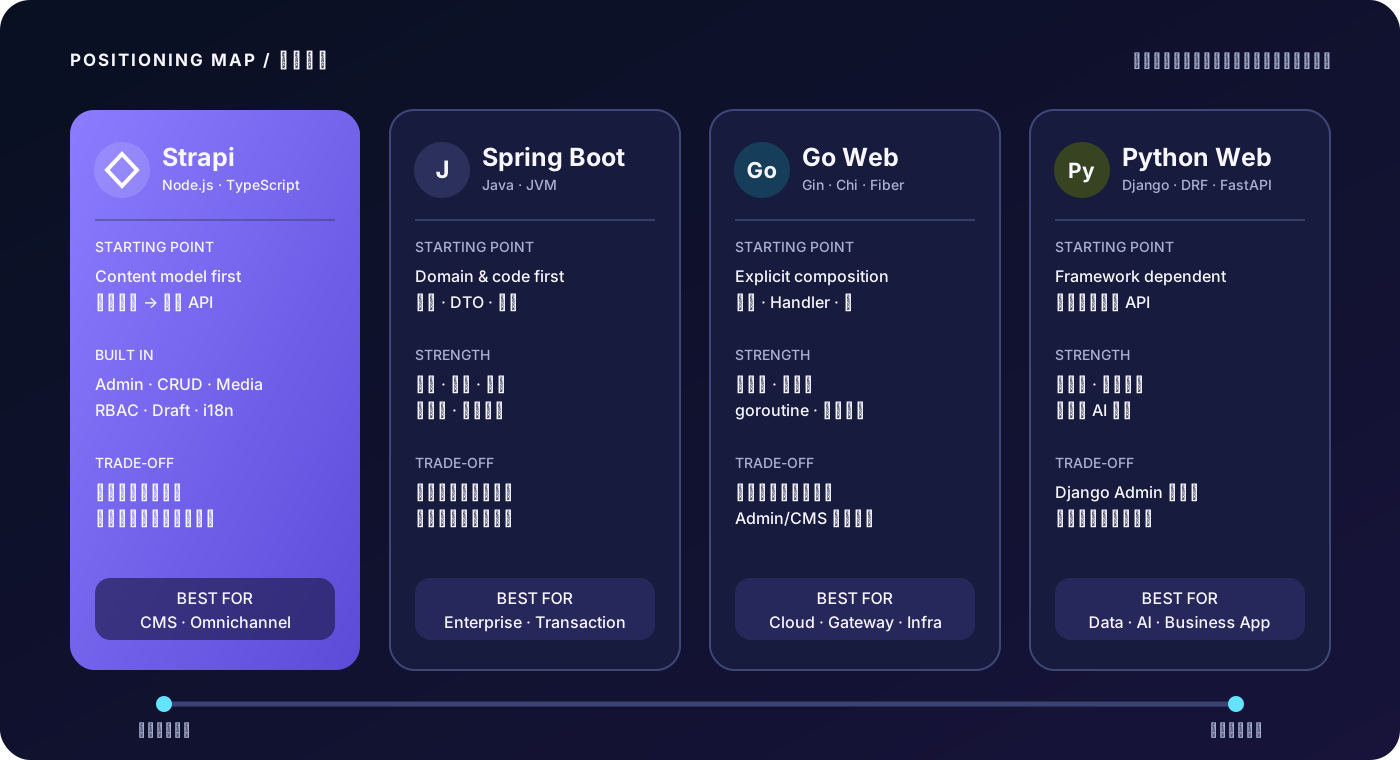
| Dimension | Strapi (Node.js/TS) | Java (Spring Boot) | Go (Gin/Chi/Fiber) | Python (Django/DRF/FastAPI) |
|---|---|---|---|---|
| Starting point | Content model first; generated CRUD and Admin | Code and domain first; explicit layers | Code first; compose focused libraries | Django is batteries-included; DRF/FastAPI define APIs in code |
| First content API | Extremely fast | Slower, but strong engineering foundations | Fast, but admin, permissions and media are separate | Django + Admin is fast; FastAPI has no content admin |
| Admin UI | A first-class feature for content teams | Usually separate or purchased | Usually separate | Django Admin is strong; FastAPI has none by default |
| Type model | TypeScript checks; JavaScript runtime | Mature strong static typing | Simple static typing and fast compilation | Dynamic by default; type hints and Pydantic add checks |
| Concurrency | Event loop, effective for I/O-heavy APIs | Threads or virtual threads, mature runtime | Lightweight goroutines | Async handles I/O; CPU-heavy work needs care |
| Runtime profile | Good for content APIs, not optimized for maximum throughput | Stable throughput; higher JVM startup and memory cost | High throughput, low memory, simple binaries | Excellent iteration speed; peak throughput is rarely the main advantage |
| Transactions/domain | Possible, but CMS abstractions do not fit every transaction | A strength: transactions, DDD, messaging and enterprise integration | Explicit and controllable; more pieces are assembled manually | Django ORM is mature; complex systems still need layering |
| Best fit | CMS, marketing sites, catalogs and omnichannel content | Core transactions and large enterprise systems | Gateways, cloud services and infrastructure | Data/AI services, business apps and rapid APIs |
Strapi vs Spring Boot
Spring Boot commonly starts with domain entities, DTOs, repositories, services and controllers. That means more code upfront, but it offers excellent control over complex transactions, messaging, audit requirements, strong contracts and large-team governance.
Strapi starts by handing you a working content platform. It can remove weeks of work for articles, authors, categories, media and localization. For settlement, inventory reservation, complex approvals or distributed business workflows, an explicit Java domain model is usually the safer center.
Strapi vs Go
Go services favor explicit dependencies, low runtime overhead and minimal deployment artifacts. They are an excellent fit for gateways, infrastructure and high-concurrency services.
Most Go frameworks do not include an editorial Admin, media library, draft publishing or granular content permissions. Strapi wins when content operations dominate; Go wins when resource efficiency, low latency and an intentionally small service are the primary goals.
Strapi vs Python
Django Admin plus Django REST Framework is the closest Python equivalent. Django is a general web framework whose Admin is primarily an internal data-management interface. Strapi begins from structured content, editor experience and multichannel delivery.
FastAPI is lighter and excellent for typed APIs, data products and AI services, but it does not automatically become a complete CMS.
6. When should you choose Strapi?
Strong fits
- Corporate, marketing, news and editorial websites
- Multilingual or multi-brand content shared across channels
- Websites, apps and mini programs sharing campaigns, banners and articles
- Product catalogs, case studies, documentation and help centers
- Frontend teams that need a usable backend while editors need autonomy
- MVPs dominated by CRUD and content workflow requirements
Use caution
- Ledgers, payments, matching engines and other transaction-heavy cores
- Systems that must take over a large pre-existing database
- CPU-heavy computation, extreme low latency or maximum-throughput services
- APIs dominated by complex commands and cross-domain orchestration
- Teams with no Node.js/TypeScript operational experience
A practical architecture is often:
|
|
Strapi can be the content service without becoming the entire backend.
7. Production checklist
- Use PostgreSQL or MySQL for most production deployments; keep SQLite for local and genuinely small use cases.
- Apply least privilege. Do not make write endpoints public; scope API tokens by consumer.
- Select
populateandfieldsexplicitly to avoid query explosions and oversized JSON. - Put business rules in services, HTTP concerns in controllers, and authorization in policies.
- Evolve models in development and ship schemas through Git and a controlled deployment process.
- Use object storage and a CDN for media in multi-instance deployments.
- Add caching and observability: measure slow queries, error rates and event-loop delay.
- Read migration notes before upgrading, especially when using plugins or a customized Admin.
Conclusion
The most useful definition of Strapi is not “a low-code backend,” but:
A structured-content framework that generates an Admin and APIs while still letting you write ordinary Node.js/TypeScript backend code.
Its conventions and automation make content-centric delivery exceptionally fast. General Java, Go and Python stacks spend more explicit code to gain broader domain control, different performance profiles or specialized ecosystems.
- If the central problem is managing and distributing content, consider Strapi first.
- If it is complex transactions, extreme efficiency or specialized computation, start with Java, Go or Python.
- If both problems exist, let Strapi own content and collaborate with the core business backend.
References
- Strapi 5 Documentation
- REST API Reference
- Back-end Customization
- Document Service API
- GraphQL API
- Database Configuration
- Strapi GitHub Repository
This article reflects the Strapi 5 documentation available in July 2026. Commands, runtime requirements and plugin behavior can change; check the documentation for the exact version you deploy.